
So, you want to write something destined to be described with the timeless word: good. Maybe profound. Captivating would be better. Something groundbreaking in its originality. Something people will not only lose themselves reading but trip over their feet running to share with others. Something beyond mere distraction, beyond filling time, beyond eyes glazing left to right through familiar, predictable tropes. Something that will entangle readers so deep within your narrative webs, trapping them with such violent dalliance, they will lose themselves entirely in its throes. So, yeah, you know, something good or whatever.
You want to place readers atop Falkor’s back, slap the luck dragon’s ass, and send them off to save Fantasia from the nothing. You want them scrambling to shield Katniss from the other tributes, flames of rebellion igniting in their guts. You want them not only refusing to put down your story but grabbing their staff and cloak to scamper off after Bilbo—barefoot, of course. You want to create something worth remembering. Something worthy of buying the hardback copy to display on a tall, oak bookshelf beside others of its caliber. You want to craft a captivating tale, pen it in rich prose, sculpt its world from soils unknown, and populate it with complex and flawed characters whom your readers would follow into the very fires of Hell.
Maybe that last bit was a tad dramatic, but like you, I’m a writer who gets carried away. Wee!
Stories that critics say are good
You’ve gone to bookstores and flipped through pages of critically acclaimed novels. It’s intoxicating. The smell, the feeling of a new book’s pages yet to be explored and devoured. Many are stamped with awards they’ve won or have glowing reviews from other writers sprawled about the cover. I’ll go as far as to bet that you’ve strongly agreed with some of those accolades, but on the other hand, some have completely missed the mark for you.
And that, my friend, is kind of my point.
I’ve read many acclaimed books that moved me and wowed me and made me feel like an absolute novice at the craft I love. There are masters out there whose imaginations and prose leave me breathless, begging to one day be even a fraction of the storyteller they are.
I’ve also read acclaimed books and found them to be underwhelming, whelming, or absolute dogshit. Predictable, tired plots. Characters with no redeeming qualities, or one-dimensional protagonists not even fleshed out enough to be believable. Or, worst of all, the book just may be poorly written. Grammatically, perhaps, but that is more forgivable than just lazy writing. You can tell when someone’s heart isn’t in their writing. It’s boring. DNF.
But the books I don’t like, others do. And vice versa. I’ve had plenty of conversations and debates about differing opinions. Book recommendations get quite heated between passionate readers. Just know that I’m right, and everyone else is wrong. Obviously.
Turns out, you can’t please everyone. It doesn’t matter what you write, how you write it, or how carefully you consider the opinions and tastes of others. This may surprise you, but people disagree on everything! Sure, everyone fundamentally knows this, but as artists, we tend to forget it when trying to create a product we want others to not only buy but like. The pressure! We try to predict what will be popular. We try to be trendy. We try to make sure everyone feels represented. And we water down, and we water down, and we water down. The more you try to please everyone, the more boring and flatter and greyer your story will feel.
Moral of the story: I often disagree with critics. Gasp! Just like you do. Many readers and critics will find my writing not to their liking, or perhaps they’ll find it straight up dogshit. Others will praise my craft for its brilliance, creativity, and originality. Both are true if I ask enough opinions. But regardless of anyone else’s opinion, I love my writing, which brings me neatly along to the main point.
Write a story for you
The first and main person you want to review your story as “good” is you. That’s it. That’s the profound answer. Surprise! You are the demographic. Maybe that’s not groundbreaking advice, but it is the simple, pure truth that will create the best version of your story—at least the rough draft. Grammar, structure, whatever needs to be cut or added, and all that other stuff can come later. Blah blah blah. You can’t prune a tree you’ve yet to grow.
Write a story you want to read. You want other people to read it, right? Ask yourself first: Would you? What kind of story do you want to read? What adventure? Romance? Horror? Bleed that onto the page. Readers aren’t stupid. They can tell when a story matters to the author. You want to make others emotional? Break your own heart. Want a hero? Who would you cheer for? Want to make a memorable villain? Write someone you hate. If you waste time focusing on what you think others want or on what critics will praise, you will find yourself wading around the swamps of mediocrity until not even you like what you’re writing. Don’t worry about them. You are your first and most important target audience. Readers want to feel the heat of your passion when they crack the cover of your book.
Parachute Minds
When I wrote Leap of Fate, the first installment of Parachute Minds, I started by asking myself what do I want to read. Had to ponder that for a while. I’m well aware that I’m selfish, in that I wanted to read everything. In turn, I wanted to write everything. A futuristic sci-fi novel with groundbreaking technological evolutions. A modern fantasy with ties to ancient mythology. A grounded tale of modern exploration. A philosophical odyssey. I wrestled with them all for a while, and the answer came at a time when I wasn’t trying to force one.
I’m a lifelong fan of sitting around a campfire with family and friends, sometimes talking about ideas, others laughing at stupid jokes, or some just staring silently into the flames. But one night, I remember being struck by such profound inspiration, I had no choice but to start writing the odyssey I desperately wanted to read.
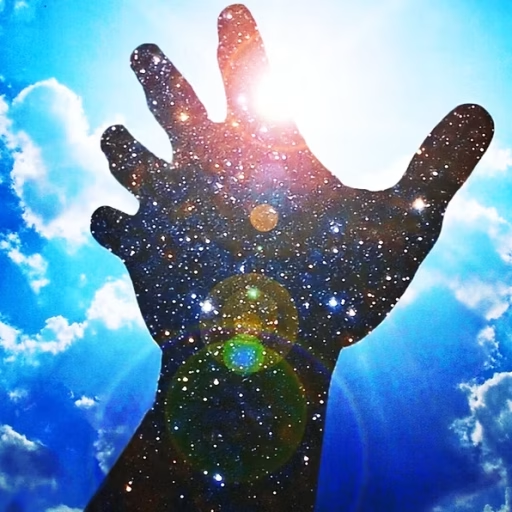
The air was cold, my breath naught but ghosts upon it. Conversations were carrying on around me, but the world muffled, save for the crackling embers, as I stared heavenward. I was enthralled by the brightness of the stars, something within me primitively summoned by their call. A couple glasses of wine, and I reached a hand toward the cosmos, silhouetting it against the twinkling lights reaching back. I remember wishing I could harness the power of light, grab it inside my fist, and travel to distant places across the universe. That idea grew like a weed, and before the same night was over, I was writing a story about harnessing the power of “elastic light” to transport explorers across galaxies. What if other habitable worlds exist? What if intelligent life is not only out there but is at different evolutionary stages? What if we could visit them, immerse in their cultures, learn, and search for answers together? What if by exploring beyond the universal horizon, we could be recruited into the most feared question presented across the stars: What is the fourth phase?
My fingers couldn’t type fast enough. Yes, I was the author—of course—but more than that, the story was for me. I was the reader. I needed to know what would happen next. I wanted desperately to grab hold of elastic light and shoot across the universe alongside Gideon. Whether a reader or a critic likes Parachute Minds matters. Of course, it does, but it pales in comparison to my own feelings for it. Whether someone loves or hates my work, they are going to experience it for a brief time and then read something else. For me, however, that story is mine forever, and regardless of what anyone else thinks, I love returning to the works I write for myself.
What story do you desperately want to read? Write that!
What piece of writing advice has helped you the most?
 Miah Sanchezmoe
Leave a comment